http://www.eaae-astronomy.org/sunrise-project/
The EAAE is proud to announce that the EAAE Sunrise Project 2011 is now officially open. Once again schools are invited to participate and make wonderful pinhole camera pictures. Registration dealine is February 20th, 2011.
The project intends to be a school collaborative project by which the schools can learn more about the Sun's apparent movement and about photography using a pinhole camera. Though the technique is in theory quite simple, pinhole camera's are very didactical, as they allow students to learn about photography theory and practice and might allow students to obtain very beautiful images.
сряда, 9 февруари 2011 г.

четвъртък, 27 януари 2011 г.
EU-HOU

Тема на курса: “EU-HOU: Практическа Вселена, Европа.
Интегриране на най-добрата интерактивна астрономия в класната стая."
Курсът се състоеше от две групи.
Основната цел на това обучение е да се възстанови интереса към науката в младото поколение с използване на методи, базирани на проучване и чрез използване на новите ИКТ. Участието на учителите в най-различни, основани на изследвания астрономически проекти цели да ги ентусиазира и мотивира да учат науки / технологии / математика. Обучението е насочено към повишаване на основните компетенции на учителите и разработване на по-високи умения, ниво и опит, преди всичко в областта на ИКТ, математика и физика. По време на курса беше стимулирано на по-нататъшното международно сътрудничество и да ентусиазирането на учениците да учат науки / технологии / математика на по-високо ниво.
Обучението имаше за цел да предостави средства в помощ на учителите да вдъхновяват учениците за учене на наука за да се избегне отстъпление към варварството. Идеята е да се даде възможност на учениците да анализират и измерват астрономически данни, за да разберат основните научни, да навлязат в на научния метод и да придобият ключови умения за мислене и активно да участват в създаването на по-устойчива икономика.
Методическата подготовка беше предложението да се направи преглед на избраните теми в астрономията.
Даден беше достъп до най-съвременните технологии, като например робот телескопи и "виртуална обсерватория» което осигурява на добра основа за използване на ИКТ за обучение. Бяха организирани практически сесии като например он-лайн наблюдения в оптичната и в радио диапазона, построяване на спектроскоп, монтаж на galileoscope, наблюдения с телескоп на Сорбоната и на посещение на музея и обсерваторията към университета "Мария и Пиер Кюри", както и коктейл. Онлине дейностите могат лесно да се възпроизведат в класната стая след обучението. Бяха проведени ИКТ упражнения на базата на астрономически данни и със софтуер (SalsaJ) в компютърна зала. Тези упражнения са били тествани в средните училища от различни страни-партньори на проекта и са предназначени да бъдат въведени в класните стаи. Беше ни показано как да се регистрираме в ЕС HOU форума, за да се присъединим към мрежата на учителите ЕU-HOU . Беше ни даден достъп до дистанционно управление телескопи.
Образователни материали и допълнителна информация са на разположение на уеб сайта. Те са разработени от проекта ЕU-HOU (http://www.euhou.net/), финансиран от Европейската комисия.
SalsaJ

SalsaJ е безплатен, лесен за използване от учениците софтуер, разработен специално за ЕС-HOU проекта. Той е проектиран да бъде лесен за инсталиране и използване. Дава възможност на учениците да анализират и опознаят истински астрономически изображения и други данни по същия начин, както професионалните астрономи го правят,което е доста вълненуващо. Няколко упражнения, разработени с пълни данни може да изтеглите, заедно с подробни инструкции за употреба. Гъвкавостта на инструмента SalsaJ дава възможност на ученици и учители да се разширят упражненията с техните собствени наблюдения.
Подробности на:
http://www.euhou.net/index.php?option=com_content&task=view&id=7&Itemid=9
сряда, 19 януари 2011 г.

black holls
http://www.athenaweb.org/programs/video/high/Astronomie,%20Astrophysic,%20Astrophysique,%20Black%20Hole,%20Trou%20Noir-1001090.html
понеделник, 10 януари 2011 г.
10-Year-Old Canadian Girl Spots Supernova

http://www.bbc.co.uk/news/world-us-canada-12110747
Things got pretty exciting in the tiny town of Birdton, New Brunswick, on Sunday.
Supernova 2010lt
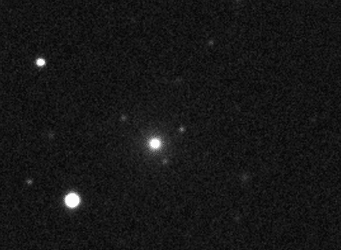
A pair of images by Canadian amateur David Lane reveal the presence of Supernova 2010xl. It's about 25 arcseconds to the northwest (upper right) of host galaxy UGC 3378.
David Lane
For months, 10-year-old Kathryn Gray had been itching to hunt for supernovas. That's only natural, since her dad (Paul) already had six finds to his credit. As he tells it, "She heard me telling my wife about Caroline Moore," the New York teenager whose supernova discovery in 2008 got her a photo-op with President Obama at a White House star party.
Kathryn had seen Paul poring over supernova-patrol photos and piped up that she wanted to try. "If a 14-year-old can do it, I can do it," she insisted.
After a test run proved she could pick out suspicious brightenings in before/after image sets, Paul asked his long-time observing buddy Dave Lane to shoot a few dozen galaxy fields on New Year's Eve. Two days later, under Paul's watchful eye, Kathryn started checking for supernovas by using a computer to compare the just-shot photos with older ones. When the fourth pair of photos appeared, she said, "What's that? Could that be one?"
Amazed, Dad took a closer look. Sure enough, something was blinking in and out of view just to the northwest of UGC 3378, a 15th-magnitude galaxy in Camelopardalis some 240 million light-years distant.
A quick check showed that the 17th-magnitude blip was neither an interloping asteroid nor a known supernova. A few hours later Illinois amateur Brian Tieman confirmed the find, which was soon designated SN 2010lt, and the next day spectra taken at Whipple Observatory in Arizona pegged it as a Type 1a explosion caught near maximum brightness.
Kathryn Gray on BBC
Spotting Supernova 2010lt was quite an accomplishment for 10-year-old Kathryn Gray, seen here during an interview on Canadian television shortly after the discovery's announcement.
BBC Canada
Some dedicated observers invest thousands of hours trying to find exploding stars. Kathryn Aurora Gray found her first one in less than 15 minutes. Just like that, she'd become the youngest discoverer of a supernova.
"I was kind of excited that I might have found one," she told NPR's Melissa Block during an interview yesterday. "But I didn't want to get my hopes too high in case it wasn't."
It's been whirlwind of media attention for young Kathryn since news of the supernova broke — interviews on NPR and the BBC one day, CNN and Fox News the next. I'm guessing "Show and Tell" at her school was over the top too.
You can read more about Kathryn and her "discovery team" in a press release from the Royal Astronomical Society of Canada and at the website for Lane's Abbey Ridge Observatory.
Posted by Kelly Beatty, January 5, 2011
събота, 11 декември 2010 г.
NASA Engineer Shows YouTube “Best of the Best” Shuttle Videos
Matt Melis, a longtime NASA engineer, has take to the ‘Tube to show off what he calls “the best of the best” imagery from shuttle launches, including hi-definition video
Melis has been in the launch analysis game for quite some time. His 45-minute tribute to space shuttle launches is incredibly educational and a fascinating watch for fans of space programs.
You’ll get to hear NASA engineers explain every imaginable detail of a shuttle launch as footage from the ground and from the shuttles themselves show what goes into the first phase of a successful space mission. You’ll get to see launches for STS-114, STS-117, and STS-124 missions.
In short, if you’re really into space stuff, this YouTube video is the director’s commentary of your dreams.
“Photographic documentation of a space shuttle launch plays a critical role in the engineering analysis and evaluation process that takes place during each and every mission,” Melis writes on the YouTube video page.
“Motion and still images enable shuttle engineers to visually identify off-nominal events and conditions requiring corrective action to ensure mission safety and success… Rendered in the highest definition possible, this production is a tribute to the dozens of men and women of the shuttle imaging team and the 30 years of achievement of the Space Shuttle Program.”
Melis has been at the Glenn Research Center in Cleveland, Ohio, for many years. He was part of the ballistics team that analyzed the Columbia launch accident, for example.
http://mashable.com/2010/12/11/nasa-youtube-shuttle-launch/
петък, 3 декември 2010 г.
SalsaJ
SalsaJ is free, student-friendly software developed specifically for the EU-HOU project. SalsaJ is designed to be easy to install and use. It allows students to display, analyse, and explore real astronomical images and other data in the same way that professional astronomers do, making the same kind of discoveries that lead to true excitement about science. A number of exercises have developed complete with data to download and detailed instructions for use. The flexibility of the SalsaJ tool enables students and teachers to extend the exercises with their own observations.
SalsaJ is multi-platform and multi-lingual: SalsaJ has been translated into many languages: English, French, Spanish, Italian, Polish, Greek, Portuguese, Swedish, Northern Sami, Arabic, Chinese.
http://www.euhou.net/index.php?option=com_content&task=view&id=7&Itemid=9
SalsaJ is multi-platform and multi-lingual: SalsaJ has been translated into many languages: English, French, Spanish, Italian, Polish, Greek, Portuguese, Swedish, Northern Sami, Arabic, Chinese.
http://www.euhou.net/index.php?option=com_content&task=view&id=7&Itemid=9
Абонамент за:
Публикации (Atom)